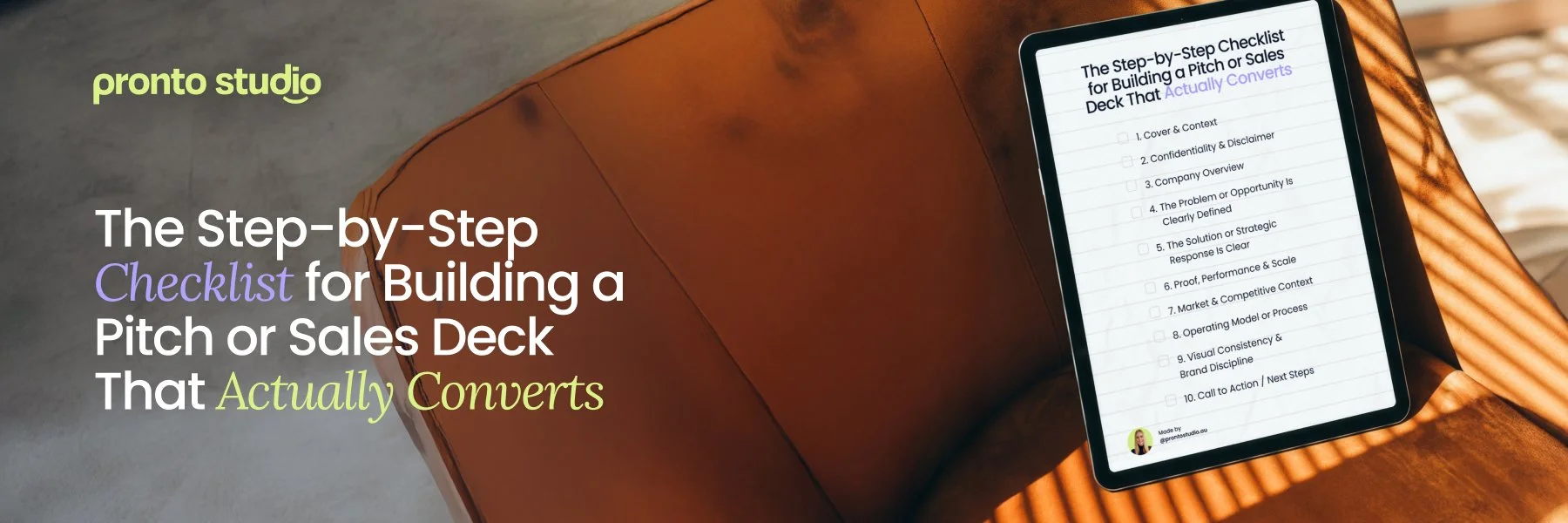
The Step-by-Step Checklist for Building a Pitch or Sales Deck That Actually Converts
TL:DRA strong pitch or sales deck is not about how many slides you use.
It is about clarity, structure, and relevance.
This checklist outlines the non-negotiables every effective deck follows, whether it’s a short sales pitch or a 40-slide corporate playbook. Each item may span one slide or many. The goal is not volume. It is making decisions easier for the audience.
Most pitch and sales decks fail because they are built without a clear point of view.
They try to explain everything. They introduce too much information too early. They rely on slides to do the talking instead of structure to do the work.
Strong decks are different. They are decisive. They are structured. They respect the audience’s time and attention.
Use this checklist as you build.
Each item in this checklist may be represented by one slide or many. The number of slides is not the point. Clarity is.
✅ 1. Cover & Context
☐ The opening slide clearly states what this deck is
☐ The audience understands the purpose immediately
☐ The tone reflects the audience and setting
What this looks like:
A clear title, short descriptor, and date that frame the purpose of the presentation without explanation or marketing language.
✅ 2. Confidentiality & Disclaimer (When Required)
☐ A disclaimer is included where appropriate
☐ The level of confidentiality is clear
☐ The audience understands how the information should be treated
Use this when:
Sharing financials or forecasts
Presenting sensitive strategy
Operating under NDA
You can skip this when:
The deck is informal or internal
No sensitive information is included
What this looks like:
A simple confidentiality slide or footer note stating how the information should be used and distributed.
✅ 3. Company Overview (Only If the Audience Needs It)
☐ The audience needs context about who you are
☐ The overview establishes credibility quickly
☐ The content is concise and relevant
What this looks like:
A single snapshot slide covering who you are, what you do, scale, and footprint. Not a full history unless it adds value.
✅ 4. The Problem or Opportunity Is Clearly Defined
☐ The problem or opportunity is specific
☐ The audience recognises themselves in it
☐ The issue is grounded in reality or data
What this looks like:
One slide clearly articulating the problem or opportunity, supported by a single strong insight or data point.
✅ 5. The Solution or Strategic Response Is Clear
☐ The response directly addresses the problem
☐ The message can be understood quickly
☐ Detail is layered later, not upfront
What this looks like:
A high-level solution slide showing what changes, what improves, and why this approach makes sense.
✅ 6. Proof, Performance & Scale
☐ Credibility is established early
☐ Proof is easy to scan
☐ The level of detail matches the audience
What this looks like:
Slides showing outcomes, performance metrics, portfolio scale, or relevant case studies. Clear, restrained, and factual.
✅ 7. Market & Competitive Context
☐ The audience understands where you sit in the market
☐ Differentiation is clear
☐ Context supports the story
What this looks like:
A simple market landscape, comparison framework, or positioning slide that clarifies how you differ without overloading detail.
✅ 8. Operating Model or Process
☐ The audience understands how things work
☐ Phases, governance, or delivery are clear
☐ Uncertainty is reduced
What this looks like:
A phased process, operating model, or timeline slide that explains how the strategy, product, or service is delivered.
✅ 9. Visual Consistency & Brand Discipline
☐ Brand templates are used consistently
☐ Visual hierarchy guides attention
☐ Nothing feels improvised
What this looks like:
Consistent layouts, brand colours, typography, and spacing across all slides. No one-off styles or ad-hoc formatting.
(We explore why this matters for attention and professionalism in How to Design a Presentation That Actually Keeps People’s Attention.)
✅ 10. Call to Action / Next Steps
☐ The deck ends with direction
☐ Decisions or actions are clear
☐ The audience knows what happens next
What this looks like:
A clear next-steps slide outlining approvals, timelines, or actions required after the presentation.
✅ Final Check: Is This Built for This Audience?
☐ The content reflects the audience and context
☐ Bespoke elements are intentional
☐ The deck feels considered, not generic
What this looks like:
A small number of slides tailored to the organisation, industry, or situation being addressed.
Final Thought
Strong pitch and sales decks are not about sounding impressive.
They are about making decisions easier.
When structure is clear, content is restrained, and the deck is built for the audience, attention stays where it should — on the message.
Save this checklist.
Use it every time you build.